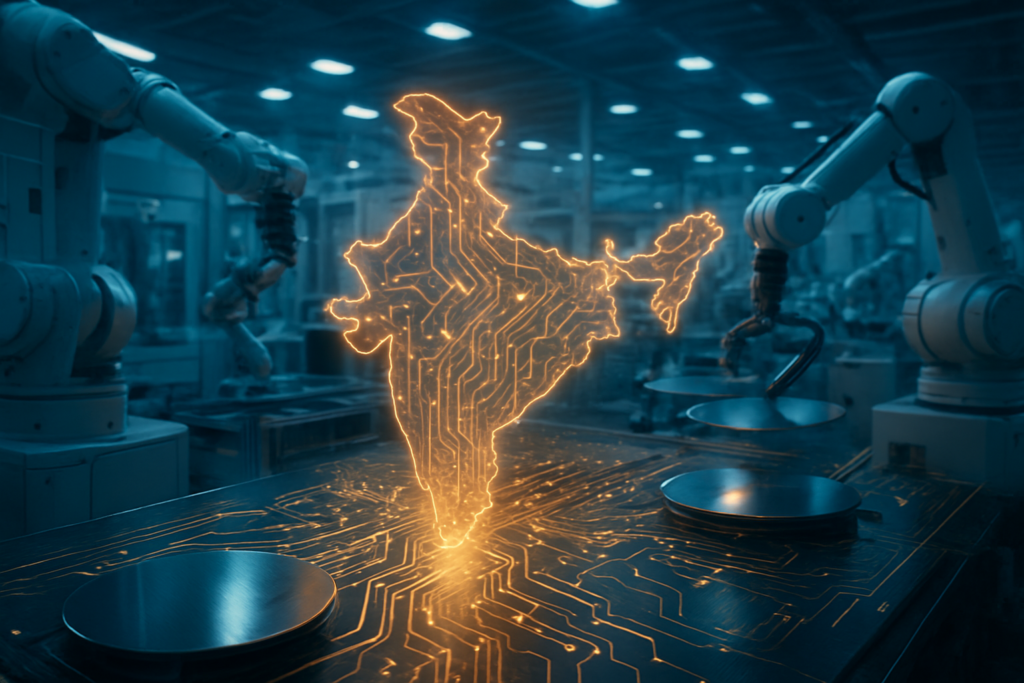
The landscape of global electronics manufacturing shifted significantly this week as India officially commenced the next phase of its ambitious semiconductor journey. The groundbreaking for the country’s first commercial semiconductor fabrication facility (fab) in the Dholera Special Investment Region (SIR) of Gujarat represents more than just a construction project; it is the physical manifestation of India’s intent to become a premier global tech hub. Spearheaded by a strategic partnership between Tata Electronics and Taiwan’s Powerchip Semiconductor Manufacturing Corp. (TWSE: 6770), the $11 billion (₹91,000 crore) facility is the cornerstone of the India Semiconductor Mission (ISM), aiming to insulate the nation from global supply chain shocks while fueling domestic high-tech growth.
This milestone comes at a critical juncture as the Indian government doubles down on its long-term vision. Union ministers have reaffirmed a target for India to rank among the top four semiconductor nations globally by 2032, with an even more aggressive goal to lead the world in specific semiconductor verticals by 2035. For a nation that has historically excelled in chip design but lagged in physical manufacturing, the Dholera fab serves as the "anchor tenant" for a massive "Semicon City" ecosystem, signaling to the world that India is no longer just a consumer of technology, but a primary architect and manufacturer of it.
Technical Specifications and Industry Impact
The Dholera fab is engineered to be a high-volume, state-of-the-art facility capable of producing 50,000 12-inch wafers per month at full capacity. Technically, the facility is focusing its initial efforts on the 28-nanometer (nm) technology node. While advanced logic chips for smartphones often utilize smaller nodes like 3nm or 5nm, the 28nm node remains the "sweet spot" for a vast array of high-demand applications. These include Power Management Integrated Circuits (PMICs), display drivers, and microcontrollers essential for the automotive and industrial sectors. The facility is also designed with the flexibility to support mature nodes ranging from 40nm to 110nm, ensuring a wide-reaching impact on the electronics ecosystem.
Initial reactions from the global semiconductor research community have been overwhelmingly positive, particularly regarding the partnership with PSMC. By leveraging the Taiwanese firm’s deep expertise in logic and memory manufacturing, Tata Electronics is bypassing decades of trial-and-error. Technical experts have noted that the "AI-integrated" infrastructure of the fab—which includes advanced automation and real-time data analytics for yield optimization—differentiates this project from traditional fabs in the region. The recent arrival of specialized lithography and etching equipment from Tokyo Electron (TYO: 8035) and other global leaders underscores the facility's readiness to meet international precision standards.
Strategic Advantages for Tech Giants and Startups
The establishment of this fab creates a seismic shift for major players across the tech spectrum. The primary beneficiary within the domestic market is the Tata Group, which can now integrate its own chips into products from Tata Motors Limited (NSE: TATAMOTORS) and its aerospace ventures. This vertical integration provides a massive strategic advantage in cost control and supply security. Furthermore, global tech giants like Micron Technology (NASDAQ: MU), which is already operating an assembly and test plant in nearby Sanand, now have a domestic wafer source, potentially reducing the lead times and logistics costs that have historically plagued the Indian electronics market.
Competitive implications are also emerging for major AI labs and hardware companies. As the Dholera fab scales, it will likely disrupt the existing dominance of East Asian manufacturing hubs. By offering a "China Plus One" alternative, India is positioning itself as a reliable secondary source for global giants like Apple and NVIDIA (NASDAQ: NVDA), who are increasingly looking to diversify their manufacturing footprints. Startups in India’s burgeoning EV and IoT sectors are also expected to see a surge in innovation, as they gain access to localized prototyping and a more responsive supply chain that was previously tethered to overseas lead times.
Broader Significance in the Global Landscape
Beyond the immediate commercial impact, the Dholera project carries profound geopolitical weight. In the broader AI and technology landscape, semiconductors have become the new "oil," and India’s entry into the fab space is a calculated move to secure technological sovereignty. This development mirrors the significant historical milestones of the 1980s when Taiwan and South Korea first entered the market; if successful, India’s 2032 goal would mark one of the fastest ascents of a nation into the semiconductor elite in history.
However, the path is not without its hurdles. Concerns have been raised regarding the massive requirements for ultrapure water and stable high-voltage power, though the Gujarat government has fast-tracked a dedicated 1.5-gigawatt power grid and specialized water treatment facilities to address these needs. Comparisons to previous failed attempts at Indian semiconductor manufacturing are inevitable, but the difference today lies in the unprecedented level of government subsidies—covering up to 50% of project costs—and the deep involvement of established industrial conglomerates like Tata Steel Limited (NSE: TATASTEEL) to provide the foundational infrastructure.
Future Horizons and Challenges
Looking ahead, the roadmap for India’s semiconductor mission is both rapid and expansive. Following the stabilization of the 28nm node, the Tata-PSMC joint venture has already hinted at plans to transition to 22nm and eventually explore smaller logic nodes by the turn of the decade. Experts predict that as the Dholera ecosystem matures, it will attract a cluster of "OSAT" (Outsourced Semiconductor Assembly and Test) and ATMP (Assembly, Testing, Marking, and Packaging) facilities, creating a fully integrated value chain on Indian soil.
The near-term focus will be on "tool-in" milestones and pilot production runs, which are expected to commence by late 2026. One of the most significant challenges on the horizon will be talent cultivation; to meet the goal of being a top-four nation, India must train hundreds of thousands of specialized engineers. Programs like the "Chips to Startup" (C2S) initiative are already underway to ensure that by the time the Dholera fab reaches peak capacity, there is a workforce ready to operate and innovate within its walls.
A New Era for Indian Silicon
In summary, the groundbreaking at Dholera is a watershed moment for the Indian economy and the global technology supply chain. By partnering with PSMC and committing billions in capital, India is transitioning from a service-oriented economy to a high-tech manufacturing powerhouse. The key takeaways are clear: the nation has a viable path to 28nm production, a massive captive market through the Tata ecosystem, and a clear, state-backed mandate to dominate the global semiconductor stage by 2032.
As we move through 2026, all eyes will be on the construction speed and the integration of supply chain partners like Applied Materials (NASDAQ: AMAT) and Lam Research (NASDAQ: LRCX) into the Dholera SIR. The success of this fab will not just be measured in wafers produced, but in the shift of the global technological balance of power. For the first time, "Made in India" chips are no longer a dream of the future, but a looming reality for the global market.
This content is intended for informational purposes only and represents analysis of current AI and semiconductor developments.
TokenRing AI delivers enterprise-grade solutions for multi-agent AI workflow orchestration, AI-powered development tools, and seamless remote collaboration platforms.
For more information, visit https://www.tokenring.ai/.