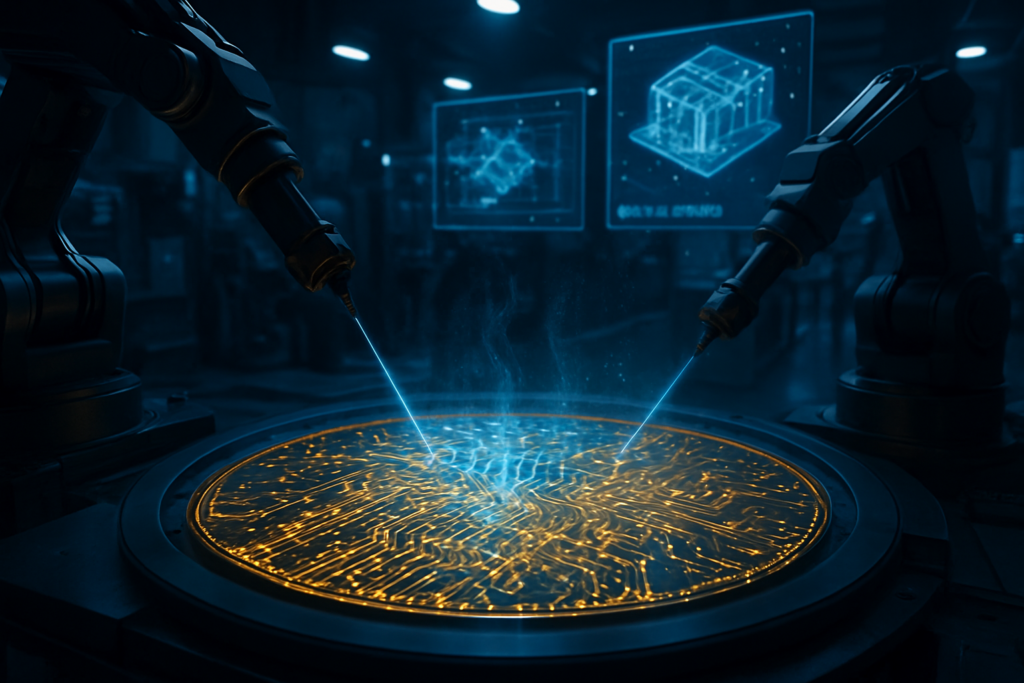
The semiconductor industry has officially crossed the threshold into the "Angstrom Era," a pivotal transition where the measurement of transistor features has shifted from nanometers to angstroms. As of early 2026, the battle for foundry leadership has narrowed to a high-stakes race between Taiwan Semiconductor Manufacturing Company (NYSE: TSM) and Intel (NASDAQ: INTC). With the demand for generative AI and high-performance computing (HPC) reaching a fever pitch, the hardware that powers these models is undergoing its most radical architectural redesign in over a decade.
The current landscape sees Intel aggressively pushing its 18A (1.8nm) process into high-volume manufacturing, while TSMC prepares its highly anticipated A16 (1.6nm) node for a late-2026 rollout. This competition is not merely a branding exercise; it represents a fundamental shift in how silicon is built, featuring the commercial debut of backside power delivery and gate-all-around (GAA) transistor structures. For the first time in nearly a decade, the "process leadership" crown is legitimately up for grabs, with profound implications for the world’s most valuable technology companies.
Technical Warfare: RibbonFETs and the Power Delivery Revolution
At the heart of the Angstrom Era are two major technical shifts: the transition to GAA transistors and the implementation of Backside Power Delivery (BSPD). Intel has taken an early lead in this department with its 18A process, which utilizes "RibbonFET" architecture and "PowerVia" technology. RibbonFET allows Intel to stack multiple horizontal nanoribbons to form the transistor channel, providing better electrostatic control and reducing power leakage compared to the older FinFET designs. Intel’s PowerVia is particularly significant as it moves the power delivery network to the underside of the wafer, decoupling it from the signal wires. This reduces "voltage droop" and allows for more efficient power distribution, which is critical for the power-hungry H100 and B200 successors from Nvidia (NASDAQ: NVDA).
TSMC, meanwhile, is countering with its A16 node, which introduces the "Super PowerRail" architecture. While TSMC’s 2nm (N2) node also uses nanosheet GAA transistors, the A16 process takes the technology a step further. Unlike Intel’s PowerVia, which uses through-silicon vias to bridge the gap, TSMC’s Super PowerRail connects power directly to the source and drain of the transistor. This approach is more manufacturing-intensive but is expected to offer a 10% speed boost or a 20% power reduction over the standard 2nm process. Industry experts suggest that TSMC’s A16 will be the "gold standard" for AI silicon due to its superior density, though Intel’s 18A is currently the first to ship at scale.
The lithography strategy also highlights a major divergence between the two giants. Intel has fully committed to ASML’s (NASDAQ: ASML) High-NA (Numerical Aperture) EUV machines for its upcoming 14A (1.4nm) process, betting that the $380 million units will be necessary to achieve the resolution required for future scaling. TSMC, in a display of manufacturing pragmatism, has opted to skip High-NA EUV for its A16 and potentially its A14 nodes, relying instead on existing Low-NA EUV multi-patterning techniques. This move allows TSMC to keep its capital expenditures lower and offer more competitive pricing to cost-sensitive customers like Apple (NASDAQ: AAPL).
The AI Foundry Gold Rush: Securing the Future of Compute
The strategic advantage of these nodes is being felt across the entire AI ecosystem. Microsoft (NASDAQ: MSFT) was one of the first major tech giants to commit to Intel’s 18A process for its custom Maia AI accelerators, seeking to diversify its supply chain and reduce its dependence on TSMC’s capacity. Intel’s positioning as a "Western alternative" has become a powerful selling point, especially as geopolitical tensions in the Taiwan Strait remain a persistent concern for Silicon Valley boardrooms. By early 2026, Intel has successfully leveraged this "national champion" status to secure massive contracts from the U.S. Department of Defense and several hyperscale cloud providers.
However, TSMC remains the undisputed king of high-end AI production. Nvidia has reportedly secured the majority of TSMC’s initial A16 capacity for its next-generation "Feynman" GPU architecture. For Nvidia, the decision to stick with TSMC is driven by the foundry’s peerless yield rates and its advanced packaging ecosystem, specifically CoWoS (Chip-on-Wafer-on-Substrate). While Intel is making strides with its "Foveros" packaging, TSMC’s ability to integrate logic chips with high-bandwidth memory (HBM) at scale remains the bottleneck for the entire AI industry, giving the Taiwanese firm a formidable moat.
Apple’s role in this race continues to be the industry’s most closely watched subplot. While Apple has long been TSMC’s largest customer, recent reports indicate that the Cupertino giant has engaged Intel’s foundry services for specific components of its M-series and A-series chips. This shift suggests that the "process lead" is no longer a winner-take-all scenario. Instead, we are entering an era of "multi-foundry" strategies, where tech giants split their orders between TSMC and Intel to mitigate risks and capitalize on specific technical strengths—Intel for early backside power and TSMC for high-volume efficiency.
Geopolitics and the End of Moore’s Law
The competition between the A16 and 18A nodes fits into a broader global trend of "silicon nationalism." The U.S. CHIPS and Science Act has provided the tailwinds necessary for Intel to build its Fab 52 in Arizona, which is now the primary site for 18A production. This development marks the first time in over a decade that the most advanced semiconductor manufacturing has occurred on American soil. For the AI landscape, this means that the availability of cutting-edge training hardware is increasingly tied to government policy and domestic manufacturing stability rather than just raw technical innovation.
This "Angstrom Era" also signals a definitive shift in the debate surrounding Moore’s Law. As the physical limits of silicon are reached, the industry is moving away from simple transistor shrinking toward complex 3D architectures and "system-level" scaling. The A16 and 14A processes represent the pinnacle of what is possible with traditional materials. The move to backside power delivery is essentially a 3D structural change that allows the industry to keep performance gains moving upward even as horizontal shrinking slows down.
Concerns remain, however, regarding the astronomical costs of these new nodes. With High-NA EUV machines costing nearly double their predecessors and the complexity of backside power adding significant steps to the manufacturing process, the price-per-transistor is no longer falling as it once did. This could lead to a widening gap between the "AI elite"—companies like Google (NASDAQ: GOOGL) and Meta (NASDAQ: META) that can afford billion-dollar silicon runs—and smaller startups that may be priced out of the most advanced hardware, potentially centralizing AI power even further.
The Horizon: 14A, A14, and the Road to 1nm
Looking toward the end of the decade, the roadmap is already becoming clear. Intel’s 14A process is slated for risk production in late 2026, aiming to be the first node to fully utilize High-NA EUV lithography for every critical layer. Intel’s goal is to reach its "10A" (1nm) node by 2028, effectively completing its "five nodes in four years" recovery plan. If successful, Intel could theoretically leapfrog TSMC in density by the turn of the decade, provided it can maintain the yields necessary for commercial viability.
TSMC is not sitting still, with its A14 (1.4nm) process already in the development pipeline. The company is expected to eventually adopt High-NA EUV once the technology matures and the cost-to-benefit ratio improves. The next frontier for both companies will be the integration of new materials beyond silicon, such as two-dimensional (2D) semiconductors like molybdenum disulfide (MoS2) and carbon nanotubes. These materials could allow for even thinner channels and faster switching speeds, potentially extending the Angstrom Era into the 2030s.
The biggest challenge facing both foundries will be energy consumption. As AI models grow, the power required to manufacture and run these chips is becoming a sustainability crisis. The focus for the next generation of nodes will likely shift from pure performance to "performance-per-watt," with innovations like optical interconnects and on-chip liquid cooling becoming standard features of the A14 and 14A generations.
A Two-Horse Race for the History Books
The duel between TSMC’s A16 and Intel’s 18A represents a historic moment in the semiconductor industry. For the first time in the 21st century, the path to the most advanced silicon is not a solitary one. TSMC’s operational excellence and "Super PowerRail" efficiency are being challenged by Intel’s "PowerVia" first-mover advantage and aggressive high-NA adoption. For the AI industry, this competition is an unmitigated win, as it drives innovation faster and provides much-needed supply chain redundancy.
As we move through 2026, the key metrics to watch will be Intel's 18A yield rates and TSMC's ability to transition its major customers to A16 without the pricing shocks associated with new architectures. The "Angstrom Era" is no longer a theoretical roadmap; it is a physical reality currently being etched into silicon across the globe. Whether the crown remains in Hsinchu or returns to Santa Clara, the real winner is the global AI economy, which now has the hardware foundation to support the next leap in machine intelligence.
This content is intended for informational purposes only and represents analysis of current AI developments.
TokenRing AI delivers enterprise-grade solutions for multi-agent AI workflow orchestration, AI-powered development tools, and seamless remote collaboration platforms.
For more information, visit https://www.tokenring.ai/.