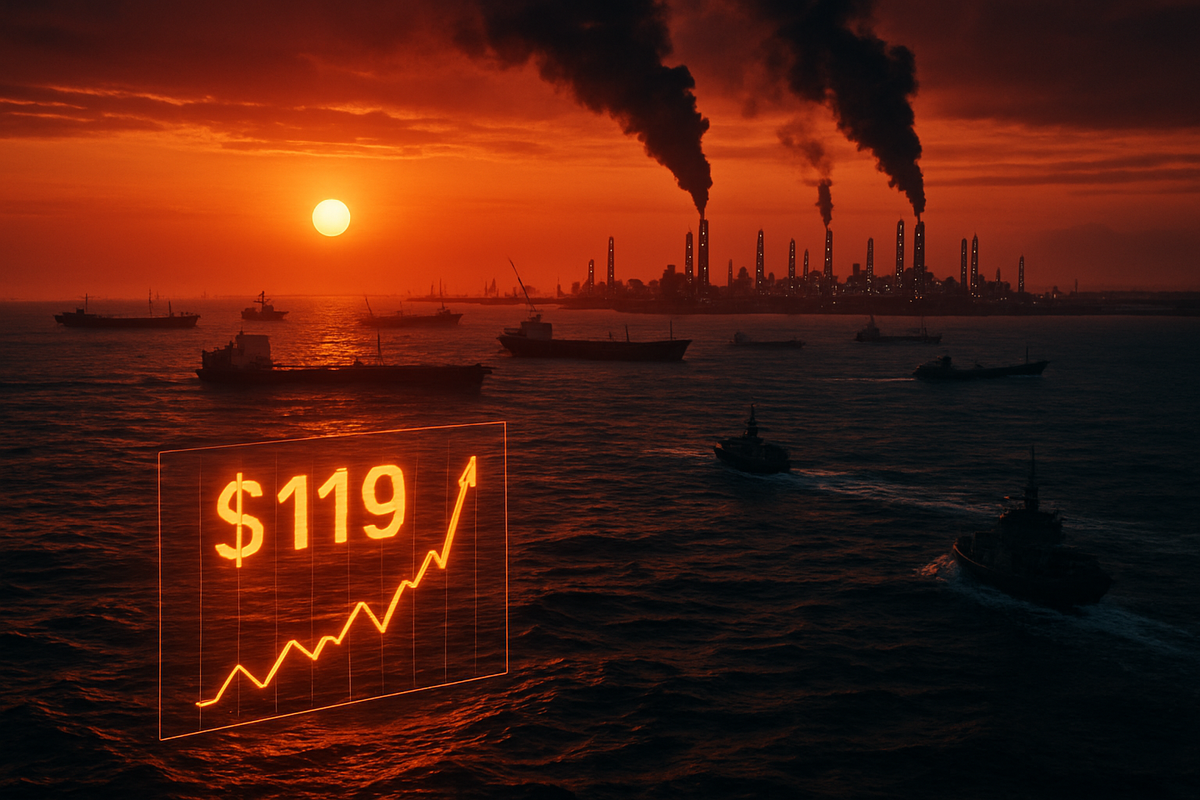
The global energy landscape has been thrust into a state of unprecedented turmoil as Brent crude oil prices soared to a staggering $119.50 per barrel this week, marking a historic 50% increase in just thirty days. This vertical climb follows a dramatic escalation in the military confrontation between the United States, Israel, and Iran, which has transformed from regional skirmishes into a high-intensity conflict threatening the very foundations of international trade. The surge is not merely speculative; it is a direct response to the physical destruction of critical energy nodes and the effective sealing of the world's most vital maritime chokepoint.
The immediate implications are dire for the global economy, as the "war premium" on oil has transitioned into a "scarcity premium." With approximately 20% of the world’s daily oil supply now stranded behind a blockade and the sudden loss of a fifth of global Liquefied Natural Gas (LNG) capacity, inflationary pressures are mounting at a pace not seen in decades. Analysts warn that if the blockade of the Strait of Hormuz persists through the next quarter, the world may face a structural energy deficit that could trigger a global recession deeper than that of 2008.
The Escalation at Ras Laffan and the Hormuz Blockade
The catalysts for this historic price explosion began in late February 2026, when long-standing tensions reached a breaking point. Following a series of targeted Israeli strikes on Iranian nuclear and military facilities—part of the coordinated "Operation Epic Fury"—Tehran responded with a multi-front assault on energy infrastructure across the Persian Gulf. The most devastating of these strikes occurred on March 2 and March 19, when waves of Iranian drones and cruise missiles targeted the Ras Laffan Industrial City in Qatar. As the world's largest LNG terminal, Ras Laffan is the lifeblood of Qatar’s economy and a cornerstone of global energy security; the attacks caused "extensive and sizeable" damage to gas-to-liquids facilities, forcing QatarEnergy to declare force majeure on dozens of international contracts.
The situation worsened on March 10, when Iran officially declared the Strait of Hormuz a "closed military zone," effectively blockaded the 21-mile-wide waterway. Over 150 merchant vessels, including massive Very Large Crude Carriers (VLCCs), are currently anchored in the Gulf of Oman, unable to transit the strait for fear of missile fire. By mid-march, the U.S. Navy and allied forces began active mine-clearing and escort operations, leading to direct naval engagements that have only heightened market fears. The timeline of this escalation has outpaced even the most pessimistic projections from the International Energy Agency (IEA), which had initially expected prices to stabilize near $90 before the Ras Laffan complex was neutralized.
Initial market reactions were chaotic. In the first 48 hours following the blockade, Brent futures jumped by $15 in a single trading session. Commodity desks at major financial institutions have been forced to revise their year-end targets twice in the last two weeks, with some now suggesting a "worst-case scenario" of $160 per barrel if diplomatic efforts fail to reopen the Strait by the end of April.
Corporate Fallout: Winners and Losers in a High-Conflict Market
The fallout from this crisis has created a stark divide between corporate "winners" who provide security and alternative energy, and "losers" whose operations are tethered to the now-crippled Middle Eastern supply chain. Among the hardest hit are the international oil majors that have invested billions into Qatari infrastructure. ExxonMobil (NYSE: XOM) and Shell (NYSE: SHEL), both major partners in the North Field expansion at Ras Laffan, are facing significant asset impairments. While high global oil prices generally benefit these firms, the physical loss of their most profitable LNG trains and the multi-year repair outlook for Qatari facilities have weighed heavily on their stock performance relative to their domestic-focused peers.
Conversely, the defense sector has seen a massive influx of capital as nations scramble to bolster their missile defense and maritime security. Lockheed Martin (NYSE: LMT) has seen its shares reach all-time highs of nearly $700, driven by an urgent demand for its THAAD and Aegis defense systems from Gulf allies. Similarly, Northrop Grumman (NYSE: NOC) is benefiting from expanded contracts for strategic deterrence and advanced surveillance technologies used to monitor Iranian movements. For these companies, the conflict has accelerated procurement cycles that would normally take years into just a few weeks.
The transportation sector is bearing the brunt of the $119 oil reality. Airlines, in particular, are seeing their margins evaporated by the 50% spike in jet fuel costs. Delta Air Lines (NYSE: DAL) and United Airlines (NASDAQ: UAL) have already announced significant surcharges and the suspension of several long-haul international routes. Having largely moved away from fuel hedging during the low-volatility period of 2024-2025, these carriers are now fully exposed to the spot market, leading to a sharp sell-off in their shares as investors fear a repeat of the 2008 airline industry crisis.
Geopolitical Risk and the New Energy Reality
The broader significance of this event cannot be overstated; it marks the definitive end of the era of "cheap energy security" that the world enjoyed for much of the early 2020s. The blockade of the Strait of Hormuz is a "black swan" event that mirrors the 1973 oil embargo in its potential to permanently shift energy policy. Governments are now likely to fast-track "energy sovereignty" initiatives, moving away from reliance on Middle Eastern fossil fuels toward domestic renewables and nuclear power. However, these are long-term solutions for a crisis that is happening in real-time.
There is also a significant ripple effect on global food security. The GCC states, which rely on the Strait for nearly 80% of their food imports, are currently facing a "grocery supply emergency." This has forced a shift in global logistics, as shipping giants like Maersk (CPH: MAERSK-B) are rerouting vessels around the Cape of Good Hope, adding weeks to transit times and thousands of dollars to shipping costs per container. This shift effectively "bakes in" higher inflation for consumer goods well into 2027, regardless of whether the military conflict subsides in the coming months.
Historically, events of this magnitude—such as the 1990 invasion of Kuwait—have led to a coordinated release of Strategic Petroleum Reserves (SPR). However, the current SPR levels in the United States and China are at historic lows, leaving policymakers with fewer tools to dampen the price shock. This lack of a "safety net" has contributed to the current geopolitical risk premium, as the market realizes that there is no "swing producer" capable of replacing the 10 million barrels per day currently sidelined by the blockade.
Looking Ahead: Scenarios for the Global Market
Looking ahead, the market is bracing for two possible scenarios. In the short term, the primary focus is on the success of the U.S.-led naval operation to reopen the Strait. If a "safe corridor" can be established by mid-April, prices may stabilize in the $90–$100 range. However, a prolonged naval war could see Brent test the $150 mark. Strategic pivots are already underway; European and Asian buyers are frantically signing long-term contracts with U.S.-based LNG exporters like Cheniere Energy (NYSE: LNG), which has suddenly become the world’s most critical supplier of gas in the wake of the Ras Laffan disaster.
In the long term, this crisis will likely accelerate the "Electrification of Everything." As the volatility of fossil fuels becomes a matter of national security rather than just economics, we expect to see a surge in subsidies for companies like First Solar (NASDAQ: FSLR) and Enphase Energy (NASDAQ: ENPH). The market opportunity for energy storage and grid resilience has never been more apparent, but the immediate challenge for these companies will be navigating the same supply chain disruptions and high shipping costs that are currently plighting the rest of the market.
Conclusion: A Market Forever Changed
To wrap up, the leap to $119 Brent crude is a symptom of a world that has lost its primary energy artery. The dual blow of the Iranian strikes on Qatar’s Ras Laffan and the total blockade of the Strait of Hormuz has created a supply vacuum that the market is struggling to fill. For investors, the takeaway is clear: the "geopolitical risk premium" is no longer a theoretical concept but a dominant market force that has reshuffled the deck for the energy, defense, and transportation sectors.
Moving forward, the market will be hyper-sensitive to any headlines regarding naval engagements in the Gulf or diplomatic breakthroughs. Investors should watch the weekly petroleum status reports and LNG export data with extreme scrutiny. While the defense sector remains a strong hedge, the broader market remains vulnerable to the inflationary "tax" of $119 oil. As of March 31, 2026, the global economy is in a race against time to restore energy flows before the current price shock turns into a permanent contraction.
This content is intended for informational purposes only and is not financial advice