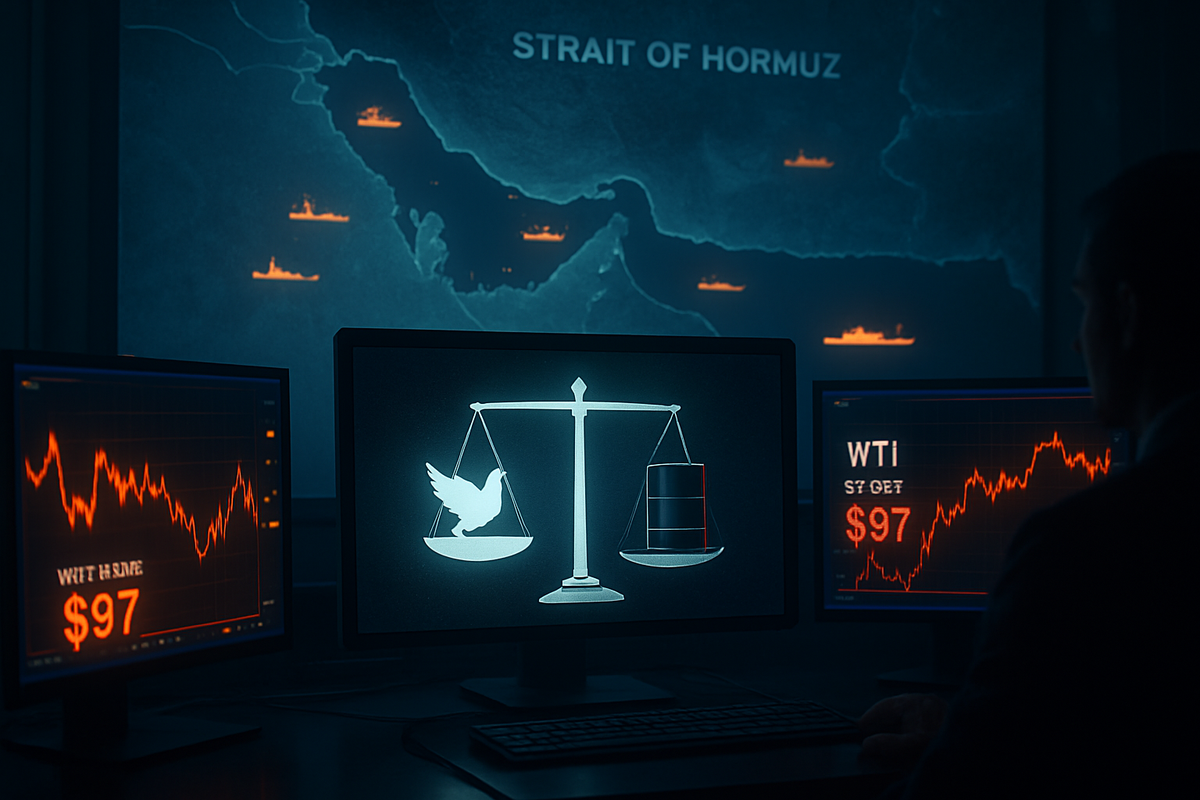
LONDON/NEW YORK — As of April 10, 2026, the global energy complex remains locked in a state of high-stakes suspense. West Texas Intermediate (WTI) crude is currently trading choppily around the $97.50 mark, a level that serves as a grim barometer for the world’s skepticism regarding a provisional 14-day ceasefire between the United States and Iran. While the guns have temporarily fallen silent, the market’s refusal to retreat to pre-conflict levels suggests that the "war premium" is far from extinguished, as traders weigh the potential for a diplomatic breakthrough against the looming threat of a catastrophic supply disruption in the Strait of Hormuz.
The immediate implications of this volatility are profound. For consumers, the $97 price point keeps global inflation expectations elevated, while for energy companies, it creates a "whiplash" environment where strategic planning is rendered nearly impossible. The ceasefire, brokered by Pakistan on April 7, was intended to pull the two nations back from the brink of a total regional war, yet the lack of a clear long-term roadmap has left the oil markets in a state of "sideways volatility," caught between the relief of a temporary peace and the reality of damaged infrastructure and frozen supply chains.
A Two-Week Window of Uncertainty
The current market environment is the direct result of a rapid and violent escalation that began in early March 2026. After six weeks of direct military exchanges, the U.S. and Iran agreed to a 14-day pause just hours before a scheduled American strike on Iranian domestic oil refineries. The ceasefire was intended to facilitate the "complete, immediate, and safe reopening" of the Strait of Hormuz, a narrow waterway responsible for approximately 21 million barrels of oil and liquefied natural gas (LNG) daily. However, the reopening has been anything but smooth.
Key stakeholders, including Pakistani mediators and U.S. State Department officials, are currently converging on Islamabad for a high-stakes summit scheduled for April 11. The primary point of contention remains the "10-Point Plan" proposed by Tehran, which demands an immediate lifting of primary and secondary sanctions in exchange for a freeze on uranium enrichment. Compounding the tension is a domestic dispute over "transit tolls" that Iran has attempted to impose on tankers moving through its territorial waters—a move the U.S. has decried as a violation of the ceasefire agreement. As of today, maritime traffic through the Strait remains at less than 10% of normal capacity, as shipowners await guarantees that "shadow mines" laid during the conflict have been cleared.
Initial market reactions saw WTI plunge from a peak of nearly $120 to a brief low of $86 per barrel immediately following the April 7 announcement. However, that "peace dividend" was short-lived. By the morning of April 10, the price had clawed back to $97, driven by reports of continued Israeli operations against Hezbollah targets in Lebanon—actions that Iran claims violate the "spirit" of the ceasefire. This delicate balance of power has forced analysts at firms like Barclays (NYSE: BCS) and ING (NYSE: ING) to warn that the market is one "wrong move" away from a super-spike toward $150.
Corporate Fallout: Winners, Losers, and the Resilient
The corporate landscape in the energy sector is being reshaped by this volatility. ExxonMobil (NYSE: XOM) has emerged as a primary example of the "double-edged sword" created by the conflict. While high prices bolstered its Q1 revenue, the company recently disclosed a 6% reduction in global oil-equivalent production due to missile damage at the Ras Laffan LNG facility in Qatar. To mitigate this, Exxon has been forced to utilize its massive long-term charter fleet to reroute products from the Atlantic Basin to Asian markets, highlighting the critical importance of logistical scale in 2026.
Chevron (NYSE: CVX) has also faced operational headwinds, having recently declared force majeure on gas deliveries from the Leviathan field in the Mediterranean. Although the company reported a restart of regular production as of April 2, its stock has seen significant pressure as investors rotate out of high-risk regional assets. Meanwhile, Occidental Petroleum (NYSE: OXY) has become a favorite among investors seeking a "geopolitical hedge." As the largest independent producer in Oman with significant assets in the UAE, OXY is deeply exposed to the Middle East, yet its robust domestic U.S. production provides a safety net that pure-play international firms lack.
On the losing side of this equation are the independent refiners and transportation firms that lack the integrated "well-to-wheel" infrastructure of the majors. These companies are facing skyrocketing maritime insurance premiums—referred to in the industry as "territorial exposure" hardening—which have made it prohibitively expensive to operate in the Persian Gulf. Conversely, companies focused on the "Atlantic Basin Triad"—the burgeoning production corridor of the U.S., Guyana, and Brazil—are seeing record investment as the market seeks alternatives to the volatile Middle East.
The Paradigm Shift in Energy Risk Management
The 2026 crisis has accelerated a fundamental shift in how the energy industry approaches risk. The traditional "just-in-time" supply chain model has been discarded in favor of a "just-in-case" strategy. This is most evident in the massive increase in "floating storage," where oil majors are leasing supertankers to serve as mobile strategic reserves, allowing them to bypass blocked transit points or wait out price spikes. This shift has also spurred a surge in the adoption of AI-enabled project portfolio management (PPM) tools, which allow executives to track financial exposure and workforce safety in real-time across multiple conflict zones.
Furthermore, the ceasefire has highlighted a growing divergence between short-term tactical hedging and long-term strategic positioning. Many firms have moved away from simple futures contracts, instead employing "Advanced Scenario Modeling" to stress-test their portfolios against extreme outcomes. This includes preparing for a "glut" scenario—where a sudden peace leads to a price crash to $60 as Iranian and damaged Gulf supplies return simultaneously—versus the "escalation" scenario where oil hits $200. This regulatory and policy pressure is also nudging the energy transition forward; as oil prices remain sticky near $100, the economic case for accelerated electrification and alternative fuels becomes increasingly undeniable for energy-importing nations.
The Road Ahead: Scenarios for the Second Quarter
Looking forward, the market’s direction will be dictated by the outcome of the Islamabad negotiations. A "best-case" scenario involves a formal extension of the ceasefire into a 90-day "cooling-off" period, accompanied by a phased removal of maritime tolls. If this occurs, WTI could stabilize in the $75–$85 range as physical supply slowly returns to the market. This would allow companies like Chevron and ExxonMobil to begin the long process of repairing damaged infrastructure and restoring their production quotas.
However, the "status quo" of a fragile ceasefire without a permanent deal is perhaps the most dangerous scenario for investors. In this "grey zone," volatility remains the only constant. Strategic pivots are already underway, with major capital expenditure being diverted toward the Permian Basin and offshore Guyana. For these companies, the goal is no longer just profit, but "geopolitical resilience." If the Islamabad talks collapse over the weekend of April 11, the market should prepare for an immediate retest of the $120 level, with the potential for further escalations to push WTI into uncharted territory.
A Precarious Balance
The current state of the oil market is a stark reminder of the fragile link between global energy security and geopolitical diplomacy. At $97 per barrel, WTI is signaling that while the world is grateful for the pause in hostilities, it does not yet believe in the peace. The ceasefire is a thin veil over a deep-seated conflict that has fundamentally altered the risk profile of the energy sector for years to come.
Moving forward, investors should watch for two key indicators: the successful clearance of mines in the Strait of Hormuz and the rhetoric coming out of the Islamabad summit. If the U.S. and Iran cannot agree on a long-term framework for sanctions and enrichment, the $97 price point will likely be remembered as a brief moment of calm before a much larger storm. For now, the energy market remains on a knife’s edge, where every headline out of the Middle East carries the weight of a $10 swing.
This content is intended for informational purposes only and is not financial advice.